
-1-2-1.jpg)
Hiring new talent for your ag business is a time-consuming, intricate process that requires careful attention to detail and dedication, and is even more demanding in the current competitive market.
A common mistake employers make when attempting their own ag recruiting is not taking the proper steps to screen candidates. Choosing a handful of applicants who look good on paper then conducting a couple of interviews, simply isn’t enough to be sure if they are the right long-term hire. Taking the time to screen each candidate properly can help you find your perfect hire faster, with less risk of turnover, and bring continued success to your farm or ag business.
Candidate screening is important because it helps organizations efficiently identify the right talent, reducing turnover rates and improving overall productivity. Effective candidate screening streamlines hiring and builds high-performing teams. A well-defined and structured screening process helps prevent hiring candidates who lack the necessary skills or experience, and prioritizes candidates who closely match your hiring criteria, ensuring a better fit for the role. Without a structured screening process, companies risk wasting resources on unsuitable candidates. In a competitive job market, a strategic screening approach can significantly improve recruitment outcomes.
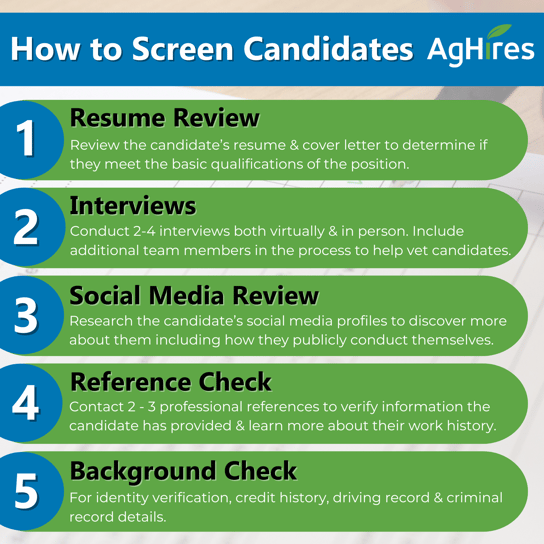
In this article, our team of ag recruiters outline 5 steps to thoroughly screen candidates and ensure they are the right hire for your agriculture operation.
1. Resume & Cover Letter
The resume and cover letter are the starting point for screening candidates, with resume review the initial step in the process. A quick glance at a candidate’s resume can give you an initial impression of the qualities they possess, or lack, and give you a general idea if they could be a potential fit for the position.
Reviewing job applications and resumes helps narrow the applicant pool to those who best meet the job description and hiring criteria, ensuring that only the most suitable candidates move forward.
Employers should use resumes as a starting point to vet candidates, but don’t overread the resumes. If a candidate’s resume checks all the other boxes besides one or two of your requirements, don’t rule them out just yet. A piece of paper cannot tell you all you need to know about a candidate. An initial interview can answer any outstanding questions or hesitations you may have about their skills or experience, so don’t rely too heavily on the resume beyond determining if they meet most of your wish list items. When reviewing resumes, it is important to look for potential concerns such as job hopping or unexplained gaps in employment history, as these may indicate issues that require further scrutiny.
Knockout questions and knockout criteria can be used in the initial application to quickly eliminate unqualified applicants and reduce the applicant pool, helping you focus on candidates who meet the non-negotiable requirements.
If the candidate includes a cover letter with their application, it can serve as an additional piece of information on the candidate’s experience, skills, and even personality. A cover letter can provide further detail on how the candidate’s skills and background can align with the role, and may include their explanation on why they were attracted to this position and see themselves as a fit.
AI-powered screening tools and automated resume screening tools can efficiently identify qualified candidates with the right skills by parsing resumes and ranking applicants based on pre-set criteria. Applicant tracking systems and automation help maintain speed and structure in the screening process without sacrificing quality.
Before reviewing applications, it is important to establish a clear job description, measurable benchmarks, and a candidate persona to ensure evaluators use the same yardstick. Listing non-negotiable minimum qualifications, such as specific degrees or legal eligibility to work, as prerequisites for candidates helps scan for knockout criteria and filter out those who do not meet basic minimums.
Screening job applicants is important because it helps identify the right person for a position and ensures candidates meet the essential qualifications and expectations for the role.
Utilizing Applicant Tracking Systems
Applicant tracking systems (ATS) have become an essential tool for modern ag recruiters looking to streamline the candidate screening process. These software solutions automatically scan and filter resumes, matching applicants to job descriptions based on relevant keywords and qualifications. By leveraging ATS, recruiters can quickly identify qualified applicants from a large pool, ensuring that only the top candidates move forward in the hiring process.
Using an ATS not only saves valuable time by reducing manual resume review, but also helps maintain consistency in how candidates are evaluated. This allows hiring managers to focus on engaging the most promising candidates rather than sifting through unqualified applicants. To get the most out of an ATS, it’s important to configure the system to accurately reflect the essential qualifications and experience required for the job. When implemented effectively, applicant tracking systems can improve the quality of hires, reduce the risk of overlooking top talent, and make the overall screening process more efficient for recruiters and employers alike.
2. Interviewing
Phone Interview
If the candidate’s resume and cover letter give you a sense of excitement, it’s time to set up the first interview. Rather than jumping straight into an in-person interview, we suggest starting with a phone screen. A phone screen is a structured, standardized 15–30-minute call used to verify resume details and assess basic communication skills. The purpose of this pre-screening interview is to determine if candidates are qualified enough to move forward in the process. Prepare standardized questions in advance to ensure consistency and fairness during the evaluation. During the phone screen, recruiters should ask questions to evaluate the candidate’s qualifications, fit for the role, and commitment to the hiring process based on their interaction. Pre-screening interviews are typically conducted over the phone or via video calls to assess communication skills and professionalism. The goal is to narrow down the candidate pool before proceeding to more detailed assessments.
In the first interview, provide the candidate with an overview of the position, what a typical day looks like, and what it’s like to work for your company. A strong candidate should come prepared with their own questions about the company and the role, too. The employer may use this time to get a better idea of the candidate’s background, skills, and future career goals. The phone interview may last anywhere from 30 minutes to an hour, and is a good starting point to explore if it’s a good fit for both parties.
Video Interview
If the phone interview goes well, an appropriate next step may be a virtual or video interview. Video interviews can be conducted live or asynchronously, allowing you to assess communication skills, professionalism, and cultural fit before advancing candidates further in the hiring process. Asynchronous video interviews allow candidates to record responses to pre-set questions at their convenience, making this method especially effective for high-volume hiring. This is where you will dive deeper into the candidate’s specific skills and relatable experience and discover their potential to step into this role successfully.
We recommend pulling in another team member or two at this stage of the interview process to gather multiple perspectives on the candidate and avoid biased opinions. This may be another company leader or team member(s) who would work directly with this hire.
On-site Interview
After a successful video interview, an in-person or on-site interview should take place next. This is a great opportunity for the candidate to meet members of the team, see the work environment, and ask more specific questions about the position. At this stage, final interviews are conducted as in-depth assessments with the top candidates to evaluate their compatibility with the role and the company's long-term objectives. Final interviews typically involve more detailed questions and interpersonal evaluation to determine the best fit before making a hiring decision.
Provide the candidate with a tour of the farm or facility and give them a clear idea of what their day in the position would look like. Have them meet with other team members to gauge their cultural fit and interactions with other employees.
Conducting 2-4 interviews with a candidate is appropriate for most positions. High-level contributors or leadership positions may require more, but it’s important to consider the candidate’s time and the nature of the position when determining how many interviews are necessary.
3. Social Media
Social media screening is when an employer gathers information on a candidate by researching their profiles and activity online. Social media sites such as Facebook, Instagram, TikTok, and X offer a free, easy glimpse into who a person really is through the content they post or interact with. Holistic evaluation during this process includes reviewing social media profiles and portfolios, which can uncover additional candidate traits that may not be evident from a standard CV. Employers may look at social media to glean insights into a candidate’s behavior and professionalism, communication skills, likelihood to succeed, and potential cultural fit into their ag business.
When using social media as a screening tool, you must take some precautions to avoid any discrimination or privacy invasion. While there are currently no state laws prohibiting you from searching candidates’ publicly available information via social media, what you do with that information can open you up to legal risk.
Some information you may discover, such as gender, race, age, disabilities, pregnancy status, political views, and religious affiliation, is legally prohibited from being used when considering candidates. However, you can use social media to consider things such as profanity, proof of drug or alcohol use, and their public online interactions with others. Employers should use social media screening to discover how a candidate publicly conducts themselves and if they would make a good cultural fit.
Learn more about social media screening.
4. Reference Checks
Reference checks are an additional screening step employers can take later in the hiring process to learn more about a candidate, especially by contacting their professional references. More specifically, about their work history, skills, and working relationships. Contacting professional references is crucial to screen job candidates and verify their credentials and work ethic.
Reference checking can help verify the information the candidate has already provided about their past work history, skills, and experience from a source other than the candidate themselves. This ensures the candidate is who they say they are, plus allows you to gather more information directly from their previous colleagues.
Before an offer is extended, contact 2-3 professional references provided by the candidate. Keep the call brief, between 5-10 minutes, and ask each reference the same set of questions. We recommend asking a handful of these questions or similar:
- What was your relationship with the candidate, and how long did you work together?
- What were their main responsibilities?
- What are they naturally great at?
- What is an area they could further grow in?
- How would you describe what it’s like to work with them?
- Have you seen them manage other employees? If so, how would you describe their management style?
- Would you like to add anything else?
Verify if the information you received from the candidate’s resume and interviews match up with the information from their professional references, and determine if they are still a candidate you would like to pursue.
5. Background Check
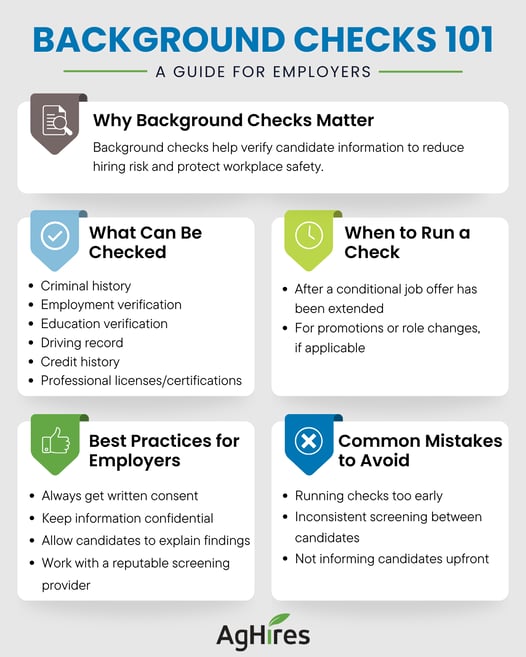
If you have completed steps 1-4, you can almost feel 100% confident about hiring your new candidate. Conducting a background check is the final step you can take to ensure you're hiring the right individual for your farm or ag business.
Background checks verify a candidate's identity, criminal record, employment history, education, and in some cases, their credit history, depending on the position. Verifying these items can help avoid mis-hires that could put your company at legal or financial risk or hurt your reputation.
Often, the background check process occurs after the offer has already been extended or even accepted. The process can take a few days, so don't wait for the results of a background check before extending your offer to avoid the risk of losing your top candidate.
Some companies conduct background checks internally, while others outsource the process. AgHires offers background check services to give you peace of mind when hiring new employees for your ag business.
Reducing Bias in the Screening Process
Creating a fair and objective screening process is critical for identifying the best candidates based on their skills and qualifications, rather than personal characteristics. One effective way to reduce bias is to use structured rubrics that focus on essential qualifications and job-related criteria. Blind resume reviews, where identifying information is removed, can also help ensure that candidates are evaluated solely on their experience and abilities.
Incorporating AI-driven scoring tools can further minimize human bias by objectively assessing candidates against the same set of criteria. During interviews, using standardized questions and evaluating responses consistently allows recruiters to compare candidates fairly and focus on the skills and qualifications that matter most for the job. By implementing these strategies, hiring managers can create a more equitable screening process, ensuring that every candidate has an equal opportunity to demonstrate their potential, regardless of their background.
Communicating with Candidates
Clear and timely communication is a cornerstone of a positive candidate experience throughout the screening process. Recruiters should keep candidates informed at every stage, from acknowledging receipt of applications to providing updates on next steps. Using templates for rejection emails, status updates, and interview invitations can help maintain consistency and efficiency in communication.
Transparency is equally important—clearly explaining the screening criteria, job requirements, and expected timelines helps candidates understand where they stand in the process. Open communication not only builds trust but also enhances your employer brand, making your company more attractive to top talent. By prioritizing effective communication, recruiters can ensure that candidates feel valued and respected, regardless of the outcome.
Measuring the Effectiveness of the Screening Process
Regularly evaluating the screening process is essential for making informed hiring decisions and continuously improving your approach. Key metrics to monitor include time-to-screen, the rate at which candidates move from screening to interviews, and candidate drop-off rates. Analyzing these data points helps recruiters identify bottlenecks, refine screening criteria, and focus on the most critical qualifications for each job.
By leveraging insights from past hiring cycles, recruiters can adjust their strategies to prioritize the skills and qualities that lead to long-term success. Continuous assessment also allows for the adoption of best practices and new technologies that can further enhance the screening process. Ultimately, measuring and refining your screening criteria ensures that you consistently identify and hire the best candidates, building stronger teams and reducing turnover in your ag business.
Partner with an Agriculture Recruitment Firm
At AgHires, we know that hiring for your farm or ag business requires time, effort, and resources that aren’t always available. Many recruiters conduct activities such as resume screenings, phone interviews, and reference and background checks to ensure candidate suitability and authenticity. Our team of agriculture recruiting experts are here to do the heavy lifting, freeing your valuable time from screening and vetting candidates.
Partnering with AgHires will help you identify potential candidates and save time in the hiring process. With our in-depth screening process and eye for identifying top talent in agriculture, we ensure we’re placing only the highest quality candidates in front of you and help move the best candidates forward in the process. Effective candidate screening combines automated technology with structured human evaluation to identify top talent efficiently.
Let AgHires find the needle in the haystack so you can focus your efforts where they’re needed most. Learn more about our professional recruiting services.
Discover more hiring advice and free resources from our team of expert agriculture recruiters by visiting AgHires.com.